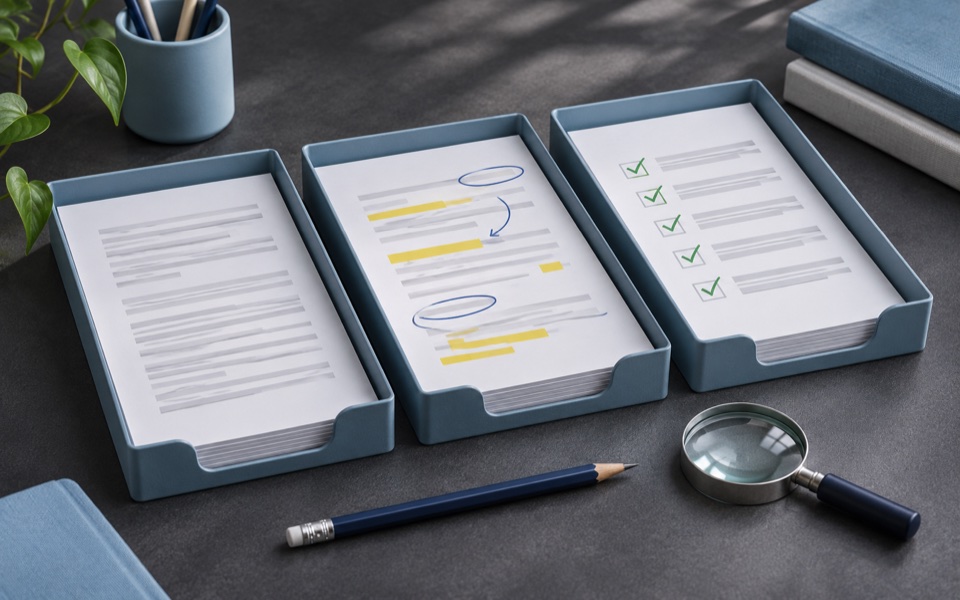
Write a fake purchase request with a blank delivery date. A second case can put different quantities on two pages. Invent names and identifiers from scratch so the file can be shared with the person reviewing the trial.
Keep a separate answer file. For each example, state whether the tool should complete the request, ask a follow-up question, or send it to a person. A sample without a known outcome can be useful for exploration, but it is hard to compare after you change the prompt. The Google Cloud evaluation guide describes assembling domain-specific examples with reference answers where needed. NIST’s generative AI profile also calls out data privacy and stronger testing with relevant inputs. Google Cloud evaluation service overview · NIST generative AI risk profile
Make a small set with specific flaws
| Fictional case | Construct it this way | Expected response |
|---|---|---|
DEMO-01 routine |
Short purchase request with one clearly named approver. | Return the approver and amount with the source field. |
DEMO-02 missing |
Copy the structure and leave the required delivery date blank. | Record the missing date and ask for it. |
DEMO-03 conflicting |
Put two amounts in separate sections and give them equal authority. | Report the conflict and cite both locations. |
DEMO-04 long |
Add several irrelevant pages and place the actual approval near the end. | Find the approved value and page within the document. |
DEMO-05 outlier |
Use a plausible format with a quantity beyond the team’s agreed range. | Keep the observed value, flag it, and route to review. |
Use values that let you spot error types. A blank quantity and a zero quantity need different answers. A date written as 03/04/2026 should exercise the workflow’s ambiguity rule. If your process relies on handwriting or screenshots, make a test image with invented information. Test whether the tool preserves the headers and reading order in a two-column example.
Make the set safe to reuse
Use a search to check the files for real organization names, addresses, IDs, URLs, and email addresses. Inspect screenshots, comments, metadata, and filenames as well as visible text. Save a clean copy and its answer file separately. Give the set a version and note the case types it covers so people can recreate it without copying live records.
Decide what needs to feel real
Model the parts of the task that make it difficult. For purchasing requests, this could include multiple tables, similar identifiers or an approval sentence in an attachment. Ask someone who handles requests which of those details most often leads to a second look. Build a new document with those features using your own words and fictional values. You can preserve the relevant structure without carrying over a single customer record. Check with the data owner before bringing any real template into the test.
Suppose a normal request has an item list, a proposed amount and an approval from a supervisor. Make one version with a known approved value and another with a statement that merely proposes it. Label the source fields in the answer key. A model may quote a perfectly recognisable number and put it in the approved field of both records. The fixture tests the distinction the receiver relies on. A cautious response can report the proposed total and leave the approved value unknown until the supervisor confirms it.
Keep the set small enough to read closely. If a page is intended to test a missing date, check that the date does not also occur in the filename or a visible note. Otherwise the answer may come from a place that real requests will not have. If you need a test with two different dates, write an explicit rule for how to interpret each date. A good example can fail in an identifiable way.
Write the answer in terms a reviewer can grade
For each case, record what the tool must return and which parts can vary. In a request that lacks an approver, a pass may mean marking the approver missing and asking for the role that would supply it. The exact wording can vary. A named person or invented date fails. For amounts, state how people should interpret a scale or decimal separator and give the source location that makes the answer true.
Give the test record a case identifier and a version. Use separate files for the input and answer. If the prompt includes examples, do not copy them from the acceptance cases. Ask the person grading a sample to explain a borderline judgment, such as whether returning a plausible delivery date is ever acceptable. Record the agreed decision in the answer file and use it the next time somebody runs the test.
Keep surprises as new cases
When a pilot shows a repeatable failure, recreate its shape with different names and numbers. For example, if a tool keeps taking an amount from the first page while the authorised amount appears on the second, make a fresh two-page request test. Keep both values distinct. Use that case to diagnose the issue, then check a second example pulled from an unseen set to see whether the fix carries over. The two-week pilot plan gives the check a place in the overall acceptance decision.
Before sharing test files, open them the way the recipient will. Inspect thumbnails, hidden rows, comments and attached media that might have been copied from an original. Check analysis output for names or URLs that came from an unapproved input. Record which variants remain untested. If a team needs to check a layout you cannot reproduce safely, leave it pending an approved sample. Keeping that gap visible helps prevent the pilot's results from being applied to a document type it never encountered.
If a file tests a numerical limit, make a matched pair that differs by one value. Put one quantity just inside the limit and the other just above it. Ask the grader to check that the evaluator can distinguish the expected accept and review outcomes. Using essentially the same layout here makes the threshold itself observable. In another pair, keep the quantity identical and change the stated unit. That will catch a tool that treats values with different units as interchangeable.