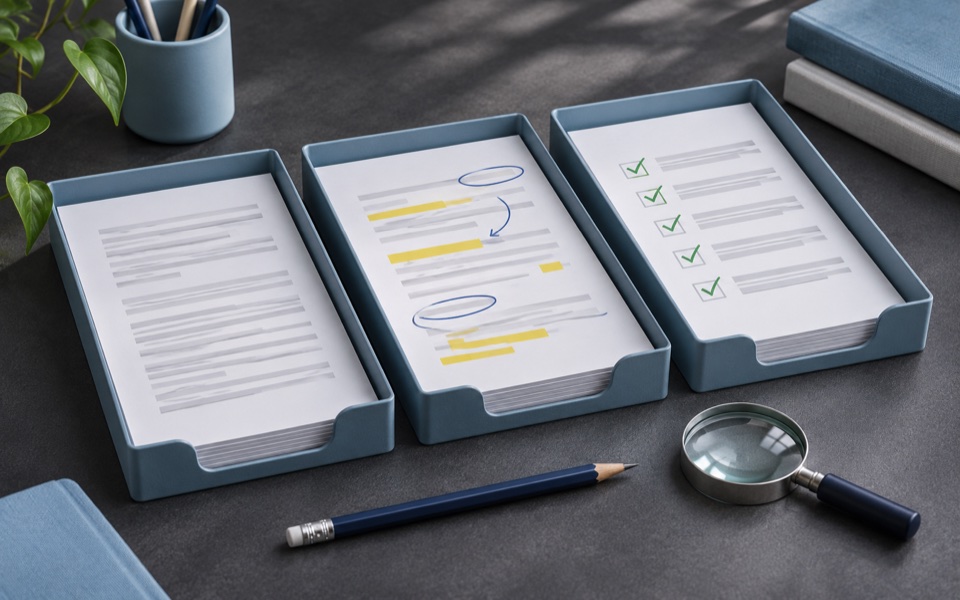
For two weeks, test whether AI can draft acknowledgements for already categorized support requests. Give each request a documented next step. That lets a reviewer confirm whether the draft matches the team’s policy before counting it as completed work.
Pick work you can score from the finished result. A reviewer should be able to tell whether a reply uses the right category, accurately describes the next step, and avoids a promise the team cannot keep. Keep the users, app version, input rules, and tool permissions in one record. NIST’s generative AI profile treats evaluation and oversight as ongoing work. Use the pilot to set the conditions under which the team would keep evaluating. NIST generative AI risk profile
Week one establishes the baseline
Write a short task statement and name a reviewer. Measure accepted replies made using the usual method, including the time to look up a policy and check the wording. Use permitted records or invented cases with equivalent structure. While you prepare the AI prompt, keep a separate set of test cases out of the tuning process. Google’s evaluation guide recommends examples that reflect the actual use case and allows reference answers for metrics that need them. Google Cloud evaluation service overview
A useful record has one row per case. Include the known category, required wording or relevant policy, approved result, elapsed time, and reason for further work. If another person supplies the data, write down which columns they can share and which system will hold the input. Keep delivery manual through the pilot.
Week two uses a fixed setup
Freeze the prompt and repeat the task on the cases you held aside. Measure the time through an approved reply. Have the reviewer score both the usual and assisted routes with the same criteria, without a route label when possible. Use a comparison group with equivalent cases or rotate which route each operator uses so that the second attempt does not simply benefit from having read the case already.
| Example pilot decision | Evidence to collect |
|---|---|
| Quality threshold | At least 18 of 20 assisted replies ready after the first review. |
| Stop condition | Any incorrect policy promise that reaches approval for sending. |
| Time threshold | Median time to approval at least two minutes below the usual route. |
The cutoffs are illustrative. Choose yours before reviewing the results. A case that requires manual fallback still counts, using the time and quality outcome for the route you actually followed.
Pick a task where the team knows the right outcome
A support team could select receipt acknowledgements for requests already assigned to a category. Suppose a help-desk policy says hardware replacement requests first go to the inventory lead. A draft can say where the request goes next without promising a date for the replacement. Keep the first trial within this case family. Ask a reviewer to verify the intended category and wording for each example before turning on the assisted route. A reasonable sounding acknowledgement can still introduce a guarantee the organisation never made.
List the inputs the person doing the work can actually use. For example, they may have a category, a ticket reference and a public policy excerpt. They may have no reason to see the customer's billing history. Use a test workspace without send or record-update permissions when possible. If the normal job involves a sensitive field the pilot cannot use, make that limitation visible in the task description and choose a narrower comparison.
Write the test cases before using the tool. Include a routine request, one whose category is incomplete and one where the policy requires a follow-up question before any commitment. Keep the last two in the comparison if they occur in real work. An acknowledgment that takes just seconds on an obvious case can still create review effort every time the ticket is incomplete. For additional fixtures, use the guide to inventing test data.
Measure from the same starting and stopping points
Start the timer when a person opens the prepared request. Stop when the reviewer can approve it. Record time spent reading, checking policy, editing, and reworking or escalating the response when needed. For the usual route, keep the same starting request and permission to consult the policy. This avoids comparing a drafted email on one side with a checked and approved response on the other.
For a short pilot, rotate sets of similar cases across operators. If both routes use the same individual case, the second attempt can benefit from familiarity. Give each reviewer a consistent rubric and hold aside a few examples no one uses to tune prompts. Suppose the median drops from seven minutes to four, which passes the example time threshold. The quality result can still fail if several replies need a reviewer to correct unsupported commitments. Keep both results in the decision.
Track reasons in enough detail to change the trial. A wrong recipient and a typo should have different entries. A draft that says “we will send it Friday” with no such policy needs a fact correction. A stylistic change with the same meaning needs less attention. Try to avoid rewriting examples after seeing which route produced them, except as part of the actual measured review process.
Decide what the second fortnight would test
If the assisted route meets the stated conditions, keep the same send approval and observe a longer run of that task. Collect the ordinary exceptions that did not arise in two weeks. A passing result for categorised acknowledgements offers little direct evidence about a task that decides the category or sends mail on its own. Each has new failure modes, reviewers, and timing.
If the result misses the threshold, pick a repeated cause that the team can address. Perhaps the prompt has no rule for incomplete records. Add the existing rule and retest on a fresh equivalent set. If review is still slower due to source checking, keep the usual method for that case type until you gather different evidence. Save the old prompt, settings, and outcome so the next person can tell why the team changed course.